

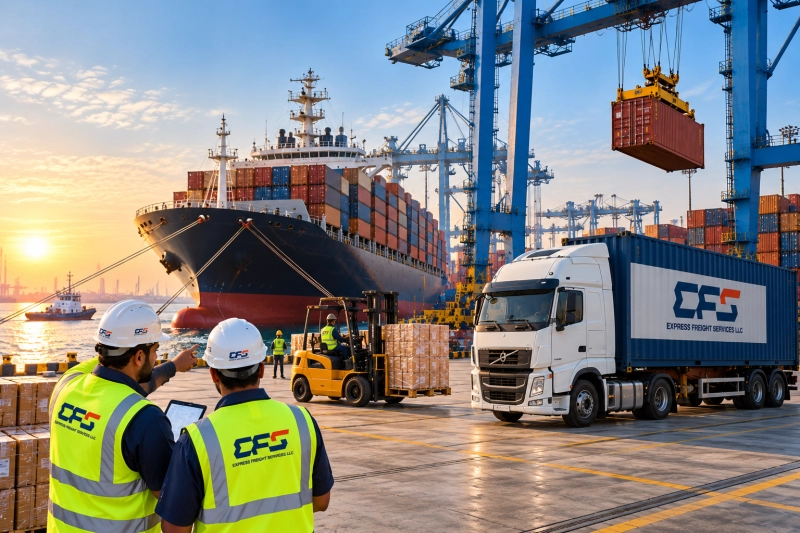
Sea freight through Dubai is rarely slow because of the ships. It is slow because of paperwork, classification errors, and customs holds that could have been avoided weeks earlier. For businesses shipping into or out of Jebel Ali Port, the practical question is not whether sea freight works, but whether the clearance process is set up correctly before the vessel arrives. Express Freight Services LLC handles this daily, and the difference between a shipment that clears in hours and one that sits for days usually comes down to preparation, not luck.
The Clearance Sequence That Actually Matters
Dubai Customs processes sea freight through a defined sequence. The container arrives, the shipping line issues the arrival notice, a customs broker submits the declaration through Dubai Trade, duties are assessed, inspection may be triggered, and only then is the container released for delivery. Each step depends on the previous one being clean.
The most useful habit is submitting documents before the vessel berths. Dubai Customs allows pre-clearance, and brokers who use it consistently see fewer storage charges at the port.
FCL, LCL and Door-to-Door: Where Clearance Gets Tricky
Full container load shipments are straightforward in principle: one shipper, one consignee, one set of documents. The risk is lower, but the stakes are higher because a single error holds an entire container.
Less than container load shipments consolidate cargo from multiple shippers into one container. This is where clearance problems multiply. If one shipment in the consolidated box has a documentation issue, the whole container can be delayed. A competent freight forwarder will isolate your cargo in the paperwork so a co-shipper’s problem does not become yours.
Door-to-door sea freight adds inland transport and final delivery to the clearance process. The customs work is the same, but the handover between port, transport, and delivery needs tighter coordination. For businesses in Oman using Dubai as a transshipment hub, the clearance at Jebel Ali is only the first step; the onward movement to the Oman border involves separate documentation and transit procedures.
Documents That Cause the Most Rejections
The documents themselves are standard: commercial invoice, packing list, bill of lading, certificate of origin, and any product-specific permits. What causes rejections is inconsistency. A commercial invoice that lists a different goods description than the bill of lading will trigger a hold. A packing list with weights that do not match the shipping line’s manifest invites inspection.
Product-specific permits are the other common trap. Food products, cosmetics, pharmaceuticals, chemicals, and certain electronics require approvals from UAE authorities before customs will release them. These permits take time to obtain, and they cannot be rushed at the port. Businesses that identify permit requirements before shipping avoid the most expensive kind of delay.
Why Tariff Classification Deserves More Attention
HS codes determine duty rates, and choosing the wrong code is both a delay risk and a compliance risk. Dubai Customs uses the harmonised system, but the specific code must reflect the actual product, not a close approximation. A shipment described vaguely as “machine parts” will be questioned more often than one with a precise code and a matching description.
This is where Customs Clearance and Documentation Services in Dubai earn their value. A broker who asks about the material composition, intended use, and country of origin before filing is doing the job properly. One who files whatever code the shipper provided without checking is creating future problems.
Practical Mistakes That Repeat
The same errors appear across industries and shipment sizes. Undervaluing goods to reduce duty is the most serious, since Dubai Customs can reassess value and impose penalties. Declaring goods as personal effects when they are commercial stock is another. Using a generic description like “general cargo” instead of the actual contents invites inspection. And leaving document preparation until after the vessel arrives guarantees storage charges at the port.
One less obvious mistake is ignoring free zone versus mainland clearance differences. Jebel Ali Free Zone has its own procedures, and cargo destined for a free zone company clears differently than cargo entering the UAE mainland. A broker who does not ask where the goods are ultimately going is missing a critical step.
Choosing the Right Support
Freight Forwarding Services in Dubai range from basic booking agents to full-service providers who manage clearance, permits, and delivery. For sea freight, the clearance capability matters more than the shipping line. A forwarder with strong relationships at Jebel Ali, a documented process for pre-clearance, and experience with your product category will consistently outperform a cheaper quote that leaves clearance to chance.
Ask specific questions before booking. How does the forwarder handle pre-clearance? Who prepares the tariff classification? What happens if inspection is triggered? The answers reveal whether you are working with a logistics partner or just a booking service.
For shipments moving onward to Oman, confirm that the forwarder understands the transit documentation and border procedures, not just the Dubai port clearance. The handover between jurisdictions is where otherwise smooth shipments stall.
Contact Express Freight Services LLC to review your sea freight clearance process before your next shipment, and get the documentation right before the vessel sails.
Frequently Asked Questions
1.How much does sea freight cost?
Sea freight pricing depends on container size, route, season, cargo type, and whether the shipment is FCL or LCL. Rates fluctuate with fuel costs and carrier capacity, so quotes are typically valid for a limited period only.
2.How much cargo per kg?
Sea freight is usually charged per container or per cubic metre for LCL shipments, not per kilogram. Weight matters mainly when cargo is dense enough to exceed the container’s weight limit, which is why dimensional weight and volume calculations drive LCL pricing.
3.Which is the best cargo service in the UAE?
The best service depends on your cargo type, destination, and clearance needs. Look for a provider with documented customs expertise, experience in your product category, and transparent pre-clearance processes rather than choosing on price alone.
4.What are the top 10 shipping companies in Dubai?
Dubai hosts major global carriers and freight forwarders operating from Jebel Ali Port and Dubai Airport Free Zone. The right choice depends on whether you need carrier capacity, freight forwarding, or integrated clearance and delivery, not just a brand name.
View More Blogs


LCL Shipping in Seeb in 2026: What Importers Should Know About Costs, Consolidation and Customs
LCL consolidation in Seeb means sharing a container with other importers so you pay only for the spa...

Oman Customs Pallet Requirement 2026: What Rustaq Importers Need to Know
Oman Customs, through the Royal Oman Police Directorate General of Customs, has introduced a mandato...

India to GCC Shipping Through Sohar Port: A Guide for Businesses
India to GCC shipping has matured into one of the most dependable trade corridors in the Indian Ocea...