

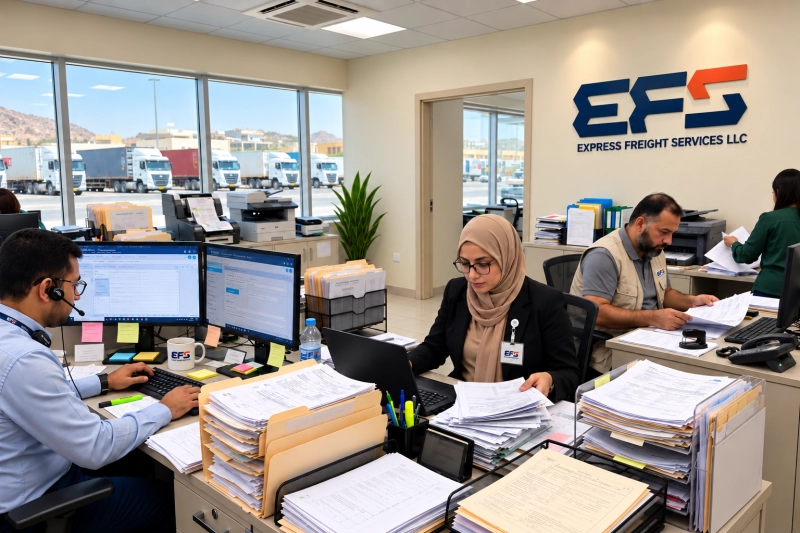
Customs clearance in Al Buraimi happens primarily at the Wajajah and Khatam Al Shakla land borders, where goods move between Oman and the UAE. The process follows the same core steps as other Omani entry points, but the land-border environment adds its own pace, paperwork quirks, and practical considerations. Working with a licensed broker such as Express Freight Services LLC can compress the timeline significantly, especially for first-time importers unfamiliar with local documentation norms.
The Al Buraimi Clearance Workflow
The sequence below reflects current practice at Omani land borders, including offices at Wajajah, Hafeet, and Khatam Al Shakla. Most brokers operating in Al Buraimi maintain 24/7 border desks, which matters because commercial traffic peaks in the early morning and late evening.
Documents That Cause the Most Delays
The standard set includes a commercial invoice, packing list, bill of lading or airway bill, and certificate of origin. For Al Buraimi specifically, brokers also ask for the vehicle registration if the goods are moving on a GCC transit movement, plus the importer’s tax card or commercial registration. A common mistake is submitting an invoice where the declared value does not match the packing list quantities. Omani customs officers at land borders cross-check these closely, and even small discrepancies can hold a truck for hours.
Restricted goods such as food products, pharmaceuticals, cosmetics, and some electronics require additional permits from the relevant Omani ministry before the border stage. These permits are issued in Muscat but must be uploaded to the customs system before the shipment reaches Al Buraimi. Attempting to arrange them at the border itself is a frequent and avoidable failure point.
Why Land Border Clearance Differs from Seaports
Sohar, Duqm, and Salalah seaports handle large consignments with longer dwell times and more structured inspection schedules. Al Buraimi’s land borders operate more like a continuous flow environment. Trucks queue, documents are processed in batches, and the practical speed depends heavily on whether the broker has a physical presence at the specific border gate. A Muscat-based agent without a Wajajah desk cannot respond to a rejected declaration as quickly as one with staff on site.
The Hafeet and Khatam Al Shakla crossings each have their own operational rhythms. Khatam Al Shakla, in particular, handles a significant share of vehicle imports and re-exports, which require additional inspection steps for chassis numbers and GCC conformity certificates. Wajajah sees higher volumes of general cargo and FMCG movements.
Choosing a Clearance Partner in Al Buraimi
The decision usually comes down to three factors: border presence, product experience, and responsiveness. A broker with offices at multiple Omani entry points, including Wajajah, Hafeet, Sohar, and Muscat International Airport, can handle shipments that shift routes mid-transit. That flexibility matters because road closures, border congestion, or UAE-side delays sometimes force a last-minute reroute through a different crossing.
- Ask a prospective broker these questions before committing:
- Do they have staff physically stationed at the Al Buraimi border you use most?
- Have they cleared your specific product category before, especially if it is food, chemicals, or vehicles?
- Can they file pre-arrival declarations, or do they only start once the truck arrives?
- What is their process for handling inspection holds or valuation disputes?
Common Mistakes to Avoid
One recurring issue is treating the commercial invoice as a formality. Omani customs uses it to assess duty, and undervaluing goods to reduce duty is a serious compliance risk that can lead to fines and shipment seizure. Another mistake is not confirming the correct HS code before dispatch. Brokers can check codes in advance, and getting this wrong at the border means a reclassification, a new assessment, and lost time.
Importers also underestimate the value of having all documents in Arabic or bilingual format. While English documents are accepted, Arabic translations speed up the review at land-border counters where officers work across multiple lanes and prefer local-language paperwork for faster verification.
What the Process Costs in Time, Not Money
Clearance time at Al Buraimi ranges from a few hours for clean, pre-filed, low-risk shipments to a full day or more when inspections, permit gaps, or valuation questions arise. The biggest variable is not the customs system itself but the completeness of the file before the truck reaches the gate. Shipments with pre-arrival filing and correct documentation typically clear faster than those processed on arrival.
For businesses moving regular volumes between the UAE and Oman, consolidating shipments through a provider offering LCL Consolidation Services in Al Buraimi can reduce the number of individual declarations and border interactions. Similarly, pairing clearance with Freight Forwarding Services in Al Buraimi keeps the transport and customs functions under one responsibility, which avoids the finger-pointing that happens when a trucking company and a broker blame each other for a delay. Companies that also need Customs Clearance Services in Al Buraimi for airfreight should confirm whether their broker handles both land-border and airport processes, since Muscat International Airport clearance follows a different workflow. For urgent shipments, Air cargo from Al Buraimi typically moves through Muscat or Dubai airports, so the clearance partner must coordinate across both the land border and the airport of departure.
To start the process, contact Express Freight Services LLC with your shipment details, HS codes, and border preference, and ask for a pre-arrival document checklist before your truck leaves origin.
Frequently Asked Questions
1.What is the cost of customs clearance?
Customs clearance costs in Oman include the customs duty itself, the broker’s service fee, and any inspection or permit charges. The total depends on the goods’ HS code classification, declared value, origin, and whether additional regulatory permits are required. Brokers typically quote after reviewing the invoice and packing list.
2.How much is custom duty in Oman?
Oman applies customs duty at a standard rate on most imported goods, with higher rates for certain products such as alcohol and tobacco, and exemptions or reduced rates under GCC trade agreements and free trade arrangements. The applicable rate depends entirely on the HS code and certificate of origin.
3.Who is the best customs clearance agent in Dubai?
The best agent in Dubai depends on the cargo type, destination, and whether the goods are transiting onward to Oman through Al Buraimi. A broker with offices on both sides of the border, including UAE and Omani clearance capability, is generally the most practical choice for cross-border shipments.
4.What documents are needed for customs clearance in Oman?
The core documents are a commercial invoice, packing list, bill of lading or airway bill, and certificate of origin. Depending on the product, importers may also need permits from Omani ministries, conformity certificates, or a commercial registration. Brokers can confirm the exact list once they see the shipment details.
View More Blogs

LCL Consolidation in Bidiyah: Benefits, Process and Shipping Tips
LCL consolidation lets businesses in Bidiyah ship smaller cargo volumes without paying for a full co...

Sea Freight Forwarding in Al Buraimi: A Complete Guide for Businesses
Sea freight forwarding in Al Buraimi connects businesses in this Omani governorate to global shippin...
What documents are needed for air cargo from Al Buraimi?
Air cargo from Al Buraimi requires a commercial invoice, packing list, air waybill (AWB), and depend...