

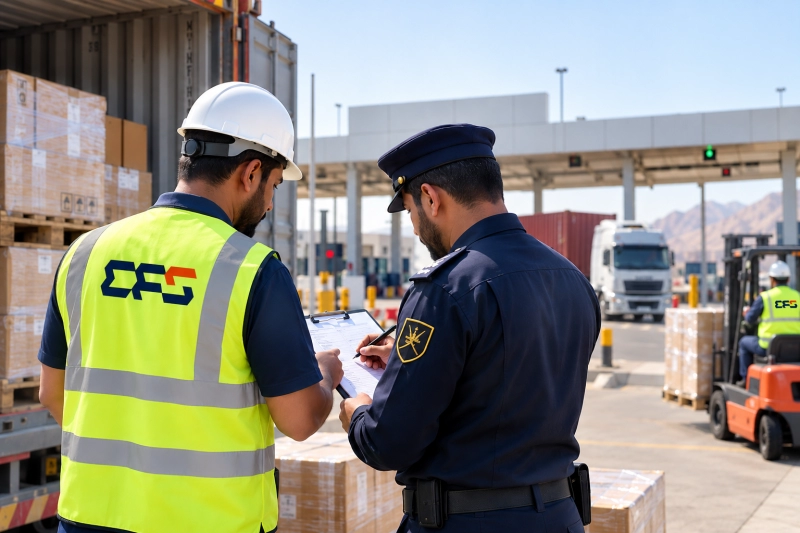
Customs clearance in Bidiyah means preparing, submitting, and getting approval for documents required to move goods legally across Oman’s borders via seaports, airports, or land crossings. It involves coordinating with Omani customs, paying duties, and meeting import/export regulations. Partnering with a provider such as Express Freight Services LLC simplifies this, but understanding the mechanics helps avoid costly mistakes.
What the Clearance Process Actually Involves in Bidiyah
Bidiyah is inland, so cargo clears through Sohar Port, Muscat International Airport, or the Hatta and Al Wajajah land borders before moving by road to Bidiyah. A customs broker or freight forwarder handles documentary work remotely, then arranges final transport. Core steps remain consistent across Omani ports and borders.
A typical clearance sequence:
- Receive and verify shipping documents from the exporter or supplier
- Submit the customs declaration through Oman’s Bayan electronic system
- Pay assessed customs duty and other charges
- Undergo inspection if customs flags the shipment
- Obtain the release order and arrange onward delivery to Bidiyah
Common documents include the commercial invoice, packing list, bill of lading or airway bill, certificate of origin, and product-specific permits. Food, pharmaceuticals, chemicals, or electrical goods may need additional approvals from Omani ministries.
Why Local Knowledge Changes the Outcome
Customs regulations in Oman are national, but practical clearance depends on which port or border post processes the shipment. A consignment entering through Sohar may face different inspection patterns than one arriving via Muscat air cargo. Experienced clearing agents understand these quirks and prepare paperwork accordingly.
Omani customs may request a bank-verified invoice or proof of payment for certain high-value shipments. Preparing this in advance prevents a multi-day hold.
Choosing Between a Broker and a Full Freight Forwarder
A customs broker focuses on documentation and duty payment. A freight forwarder offers clearance plus physical movement, which matters in Bidiyah because inland transport adds a leg a broker may not arrange.
For consolidated or smaller shipments, LCL Consolidation Services in Bidiyah reduce cost by combining goods with other consignments on the same route. For larger or time-sensitive cargo, Freight Forwarding Services in Bidiyah provide end-to-end coordination from origin to final delivery. The right choice depends on shipment size, product type, and desired control.
Practical Tips That Prevent Delays
Customs delays accumulate from small oversights. These practices reduce clearance time:
- Send complete documents before the vessel or flight arrives
- Match the invoice description exactly to the packing list and bill of lading
- Confirm the importer’s customs registration and authorised signatory are current
- Check whether the product needs a conformity certificate or Saso equivalent
- Keep a digital copy of every permit, since customs officers may request re-verification
A growing trend among Omani forwarders is pre-clearance, submitting the declaration while cargo is in transit. This works well for air freight and express sea lanes and can cut release time noticeably.
When Clearance Gets Complicated
Regulated goods such as medicines, chemicals, foodstuffs, and telecom equipment may require lab testing or ministry inspection. Used machinery and vehicles face additional valuation scrutiny. Personal effects and household goods have separate documentation rules, especially for expatriates relocating to or from Bidiyah.
An experienced agent knows which authority to contact, what evidence satisfies the requirement, and how to initiate the customs clearance process and request a re-assessment if a valuation seems incorrect. Handling a complex clearance without local representation often creates longer delays than the clearance itself.
What to Ask Before Engaging a Clearance Provider
Ask whether the provider handles your specific commodity regularly, which ports and borders they clear through most often, and whether they offer Customs Clearance and Documentation Services in Bidiyah as part of a broader logistics package. Confirm they can arrange final delivery to Bidiyah rather than stopping at the port.
Red flags include vague answers about permits, no direct contact at the customs office, and quotes disconnected from shipment details. A competent provider asks about your product, origin country, and destination before quoting.
Moving Forward with Your Shipment
Gather your commercial invoice, packing list, and product certificates, then Contact Express Freight Services LLC for a document review before your cargo ships. A quick pre-check catches classification errors and missing permits while there is still time to fix them, which is cheaper than correcting problems after arrival.
Frequently Asked Questions
1.Which customs clearance service is the best in Dubai?
No single provider is objectively best for every shipment. The right choice depends on commodity type, shipment volume, and destination. In the UAE, look for a licensed customs broker with direct experience in your product category and a track record at the specific port or airport you use.
2.How can I get custom clearance?
Customs clearance requires submitting a declaration through the country’s electronic customs system, supported by the commercial invoice, packing list, transport document, and any required permits. Most importers engage a licensed broker or freight forwarder to handle the submission and coordinate with customs authorities.
3.What are the custom clearance charges in Dubai?
Charges vary based on the customs broker’s service fee, the duty assessed on the goods, and any inspection or storage costs incurred. The duty rate depends on the HS code classification and the goods’ declared value, while broker fees depend on shipment complexity and volume.
4.How long does customs clearance take?
For standard, correctly documented shipments, clearance typically takes one to three working days after cargo arrival. Regulated goods, missing permits, inspection holds, or valuation queries can extend this to a week or more. Pre-clearance while cargo is in transit often reduces release time after arrival.
View More Blogs


India to GCC Shipping Through Sohar Port: A Guide for Businesses
India to GCC shipping has matured into one of the most dependable trade corridors in the Indian Ocea...

Land, Sea and Air Transport in Duqm: A Complete Guide for Businesses
Duqm’s transport network has grown into one of Oman’s most strategically important logistics cor...
How Much Does It Cost for Air Cargo Service in Bidiyah: A Complete Guide by Express Freight Services LLC
Air cargo is the backbone of fast international trade, but for businesses in Bidiyah, the cost quest...