

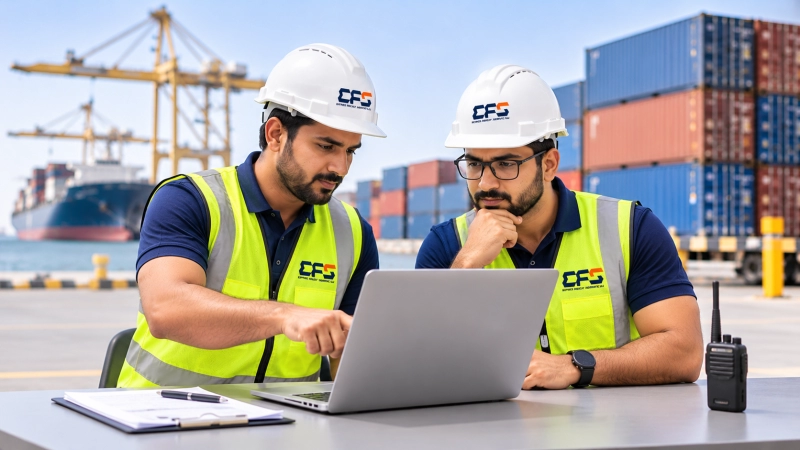
Import customs clearance in Manah works through Oman’s centralized electronic system, but practical clearance is usually handled by licensed brokers in nearby Nizwa or Muscat who coordinate with the Directorate General of Customs. For shipments arriving by sea at Sohar or by air at Muscat International Airport, the declaration is filed electronically, duties are assessed, and goods are released for onward transport to Manah. Express Freight Services LLC handles this coordination for importers across interior Oman, including Manah and the surrounding Dakhiliyah region.
Manah itself is not a designated customs port, which is the first thing importers need to understand. The town sits inland, roughly a short drive from Nizwa, so cargo physically clears at the port of entry before moving by road to its final destination. This means your clearance agent needs to manage both the port-side formalities and the inland delivery leg.
What the Clearance Process Actually Involves
The process starts before the shipment arrives. A customs declaration, known locally as the Bill of Entry, is submitted through the computerized system operated by the Directorate General of Customs. The declaration describes the goods, their value, origin, and the applicable tariff classification.
Once the declaration is accepted, the system calculates duties and any other charges. Payment is made electronically, after which customs may inspect the shipment. Inspection is not automatic for every consignment; it depends on the commodity, the importer’s compliance history, and risk profiling. If the goods match the documentation, the shipment is released.
From there, the cargo moves by road to Manah, typically via Nizwa. Transport from Muscat or Sohar to Manah is straightforward along the main highway network, but coordination matters because a shipment released late in the day may not reach Manah until the following morning.
Documents Required for Clearance
The core document set is consistent across Oman, but missing paperwork is still the most common cause of delay. Importers should prepare:
- Commercial invoice showing the seller, buyer, goods description, unit values, and total value
- Packing list with weights, dimensions, and package counts
- Bill of lading for sea freight or airway bill for air freight
- Certificate of origin, which matters for duty rates under trade agreements
- Import permits or approvals for restricted categories such as foodstuffs, pharmaceuticals, chemicals, or telecommunications equipment
For goods qualifying under the U.S.-Oman Free Trade Agreement, the certificate of origin is not a formality; it is the document that secures duty-free treatment. Without it, the standard rate applies.
Duties and Tariffs in Practice
Oman applies a customs tariff that generally does not exceed 10 percent for most foreign goods from non-GCC and non-U.S. origins. Goods from other GCC states typically enter duty-free under the Gulf Cooperation Council framework. U.S.-origin products can qualify for duty-free access when accompanied by the correct FTA documentation.
Some categories carry different treatment. Alcohol and tobacco face higher rates, and certain agricultural products may have protective duties. The tariff classification code, the HS code, determines the rate, so accurate classification is where a broker’s experience directly affects what you pay.
Common Mistakes That Delay Clearance
The most frequent problems are not exotic. They are documentation mismatches, undervaluation attempts, and missing permits.
A commercial invoice that describes goods vaguely, such as “general merchandise” or “spare parts” without detail, invites inspection and delay. Customs officers in Oman can and do request supporting documentation when the declared value appears inconsistent with the goods described.
Undervaluing goods to reduce duty is a well-known red flag. The system compares declared values against reference data, and a low declaration can trigger a valuation review that takes longer than the duty saving was worth.
Restricted goods shipped without the required permit cannot be cleared until the permit is obtained. This can mean days of storage at the port while the importer sorts out approvals.
Choosing a Clearance Route: Direct vs Broker-Assisted
For importers in Manah, the practical choice is usually a broker with a presence in Nizwa or Muscat. The broker’s local knowledge of inspection patterns, documentation standards, and the inland transport leg saves time that a remote importer would otherwise spend on phone calls and resubmissions.
Inland Movement After Clearance
Once goods are released at the port, the shipment needs to reach Manah. This is where Freight Forwarding Services in Manah come into play. A forwarder arranges the trucking, confirms delivery timing, and handles any issues that arise on the road. For smaller shipments that do not fill a container, LCL Consolidation Services in Manah allow importers to share container space and pay only for the volume they use, which is often more practical for interior destinations where full-container volumes are harder to justify.
Customs Clearance and Documentation Services in Manah, in practice, are delivered remotely by brokers who manage the port-side process while coordinating with the importer by phone, email, and document exchange. The physical location of the broker matters less than their access to the customs system and their familiarity with the commodity being imported.
Practical Advice for a Smooth Clearance
Send your broker the complete document set before the shipment departs, not after it arrives. Early document review catches issues while there is still time to correct them without port storage charges.
Describe goods precisely on the invoice. Include the HS code if you know it, and make sure the invoice value matches the actual transaction value.
Check permit requirements before purchasing. If the goods need approval from a ministry or authority, start that process in parallel with the shipment, not after it lands.
Keep a record of every clearance. A history of compliant declarations makes future clearances faster because the system’s risk profiling favours importers with clean records.
For importers in Manah and the wider Dakhiliyah region, the clearance process is manageable when the documentation is right and the broker understands both the port-side formalities and the inland delivery. Contact us today for a quick consultation on your next shipment.
FAQ
1.How long does import customs clearance completed take?
For a shipment with complete and accurate documentation, clearance at a Muscat or Sohar port typically completes within one to three working days. Inspections, permit issues, or documentation queries can extend this. The inland leg to Manah adds transport time depending on the port of entry.
2.What are the import duties in Oman?
Most foreign goods from non-GCC and non-U.S. origins are subject to a standard import duty that generally does not exceed 10 percent. GCC-origin goods typically enter duty-free, and U.S.-origin products can qualify for duty-free access under the U.S.-Oman Free Trade Agreement with the correct certificate of origin.
3.Which document is mandatory for customs clearance of imported goods?
The commercial invoice is the foundational mandatory document. It must accurately describe the goods, show the transaction value, and identify the buyer and seller. The packing list, bill of lading or airway bill, and certificate of origin are also required for most shipments.
4.Who is the customs clearance agent?
A customs clearance agent is a licensed broker authorized to file declarations with the Directorate General of Customs on behalf of importers. In the Manah area, importers typically work with brokers based in Nizwa or Muscat who manage the electronic filing, duty payment, and inspection coordination remotely.
View More Blogs

LCL Consolidation Services in Adam: A Complete Guide for Businesses
LCL consolidation services in Adam let you ship cargo too small for a full container by sharing cont...
Air Cargo Services in Adam: A Complete Guide for Businesses
Adam, in Oman’s Al Dakhiliyah Governorate, has no commercial airport or dedicated air cargo termin...
International Freight Forwarding in Adam: Shipping Process and Requirements
Freight forwarding in Adam, Oman, centres on the town’s position along the main Muscat-Salalah hig...