

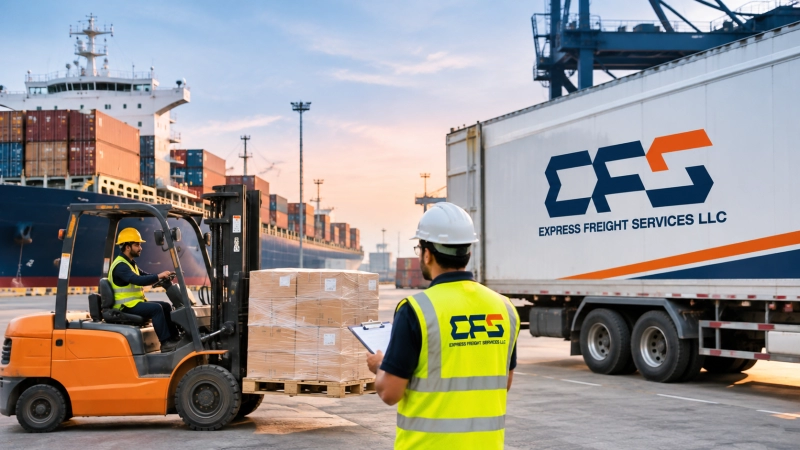
International LCL shipping to Manah means sharing container space with other consignments instead of booking a full container. Your cargo is consolidated at an origin hub, shipped to an Omani port, cleared through customs, and then trucked inland to Manah in Al Dakhiliyah Governorate. For businesses and individuals moving smaller volumes, this is usually the most practical way to import goods without paying for unused container capacity.
Express Freight Services LLC, established in 1995 and active across Oman, handles LCL consolidation through Jebel Ali with fortnightly export runs from Muscat. That kind of scheduled consolidation matters because it reduces the waiting time that often makes LCL feel slower than it needs to be.
What the LCL Journey to Manah Actually Looks Like
The process follows a predictable chain, but each link has local wrinkles worth understanding before you book.
Your goods are first collected or delivered to an origin warehouse, commonly in Dubai, Jebel Ali, or another regional hub. There they are consolidated with other shipments bound for Oman. The shared container then moves by ocean carrier to a primary Omani port, typically Port Sultan Qaboos in Muscat or Port of Sohar. After import clearance, the container is deconsolidated and your cargo is loaded onto road freight for the inland leg to Manah.
The inland leg is not an afterthought. Manah sits inland, roughly a two-hour drive from Muscat depending on the route, and the final delivery often involves a smaller truck than the one that moved the container from the port. Confirming the delivery address details, including any access restrictions, before the cargo leaves the port prevents delays and failed delivery attempts.
Key Factors That Shape Your LCL Shipment
Documentation That Keeps the Shipment Moving
Customs clearance is where LCL shipments to Manah most often stall. The paperwork itself is standard, but errors or omissions compound quickly because your cargo is one of many consignments in a shared container.
A commercial invoice, packing list, and bill of lading or waybill form the core set. Depending on the goods, you may also need a certificate of origin, import permits, or product-specific approvals. Omani customs procedures are well established, but the importer is responsible for accurate declared values and correct harmonised system codes. Getting these wrong can trigger inspection, reassessment, or additional duties.
A freight forwarder with local customs knowledge can prepare and submit documentation before the vessel arrives. This is where Customs Clearance and Documentation Services in Manah become genuinely useful, not just an administrative checkbox. Pre-clearance preparation often means the difference between same-week delivery and a shipment sitting at the port.
LCL Consolidation Services in Manah and the Inland Reality
LCL consolidation works best when the forwarder runs a reliable schedule. Consolidation hubs like Jebel Ali serve as the staging point for cargo from multiple origins, and the frequency of those consolidation runs directly affects your total transit time.
Once the container reaches Oman and clears customs, the shipment is deconsolidated at a warehouse or container freight station. From there, road freight completes the journey to Manah. This last segment is straightforward but requires coordination. Freight Forwarding Services in Manah typically include arranging the inland truck, confirming delivery windows, and handling any final documentation at the destination.
One practical point that is often missed: ask whether the quoted LCL rate includes the inland delivery to Manah or only covers port-to-port. Some quotes stop at the Omani port, leaving you to arrange and pay for the final leg separately. Clarifying this before booking avoids an unpleasant surprise.
Common Mistakes to Avoid
- Under-declaring cargo value to reduce duties, which risks fines, delays, or seizure during inspection
- Assuming the LCL rate includes customs clearance and inland delivery to Manah when it may only cover the ocean leg
- Packing goods without considering the shared container environment, where cargo shifts and rubs against other consignments
- Waiting until the shipment arrives to prepare import permits or product certifications
- Providing an incomplete Manah delivery address, especially for commercial premises without clear signage
What Experienced Shippers Watch For
Beyond price, the factors that most influence a smooth LCL shipment to Manah are consolidation frequency, customs capability, and inland delivery coordination. A forwarder with a fixed consolidation schedule from a hub like Jebel Ali can offer more predictable transit than one that waits to fill a container. Local customs expertise matters more than a marginally lower freight rate, because clearance delays erase any upfront saving.
Packing also deserves more attention than it usually gets. LCL cargo shares space, so goods should be palletised or crated where possible, with clear labelling on every package. Fragile or high-value items need protection against movement during ocean transit and during the deconsolidation process at the port.
The trade-off is honest and simple: LCL costs less than a full container for smaller volumes, but it takes longer and involves more handling. For shipments large enough to justify a full container, FCL is faster and gentler on the cargo. For everything else, LCL remains the sensible default.
Reach out to us anytime for a clear assessment of your shipment, including realistic transit times and the documents you will need before the cargo moves.
Frequently Asked Questions
1. How much does LCL shipping cost?
LCL shipping costs depend on cargo volume, weight, shipping origin, destination, and handling requirements. Additional charges may apply for documentation, customs clearance, and inland delivery to Manah.
2. How do you calculate LCL shipping charges?
LCL charges are generally calculated based on cargo volume (CBM) or weight, whichever is higher under the applicable weight/measurement (W/M) tariff. Additional costs may include handling, documentation, customs clearance, and transportation.
3. How much does it cost to ship 1 kg of cargo?
There is no fixed per-kilogram rate for LCL shipping because charges depend on cargo volume, weight, origin, and destination. Minimum freight and handling charges may also apply, so provide your shipment details to get an accurate quotation.
4. Which is cheaper: FCL or LCL shipping?
LCL is generally cheaper for smaller shipments because you pay only for the space your cargo occupies. FCL can be more economical for larger shipments that require most of a container, depending on the total shipping and handling costs.
View More Blogs

LCL Consolidation Services in Adam: A Complete Guide for Businesses
LCL consolidation services in Adam let you ship cargo too small for a full container by sharing cont...
Air Cargo Services in Adam: A Complete Guide for Businesses
Adam, in Oman’s Al Dakhiliyah Governorate, has no commercial airport or dedicated air cargo termin...
International Freight Forwarding in Adam: Shipping Process and Requirements
Freight forwarding in Adam, Oman, centres on the town’s position along the main Muscat-Salalah hig...