

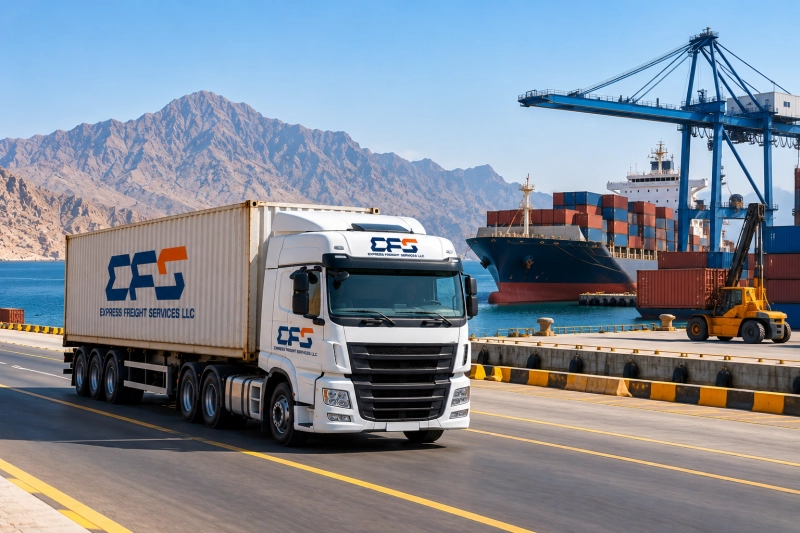
Road freight from the UAE to Khasab moves through the Musandam Peninsula, combining standard GCC trucking with border formalities specific to an Omani exclave. The journey from Dubai covers around 474 km and takes 5 to 6 hours of driving, though total delivery time usually spans 1 to 3 days once customs clearance, border queues, and final-mile handling are factored in. For commercial cargo, household goods, or project materials, a smooth shipment depends on documentation, load type, and delivery expectations. Express Freight Services LLC handles this corridor regularly, and the details below reflect how the route actually works.
What a Typical UAE to Khasab Shipment Involves
Trucks depart from Dubai, Sharjah, Abu Dhabi, or Al Ain, cross into Oman through established border posts, then follow the coastal road into Khasab. What makes Khasab different from a Muscat or Sohar delivery is geography: it sits at the northern tip of the Musandam Peninsula, separated from the rest of Oman by UAE territory. Shipments do not merge into a main Omani highway network after crossing. The final leg is a dedicated run into the peninsula, which affects scheduling and why some providers treat Khasab as a distinct destination rather than a standard Oman route.
Documents That Decide Whether Your Shipment Moves or Sits
Border delays are rarely about the road and almost always about paperwork. The document set depends on whether cargo is commercial or personal, but these are most often requested:
- Commercial invoice with accurate cargo description and value
- Packing list matching the physical load
- Certificate of origin where applicable
- Delivery order or consignee details for Khasab
- Vehicle registration and driver documentation for the truck itself
A vague cargo description consistently slows shipments. Omani customs at Musandam entry points can ask for clarification on generic terms like “general goods” or “spare parts.” A precise description, including material and intended use, moves faster. A mismatch between invoice and physical pallet count is another common issue. Customs officers may inspect when numbers do not align, and an inspection at a smaller border post can add hours.
For commercial shipments, working with a provider that handles Customs Clearance and Documentation Services in Khasab removes much of this friction. The service matters because the final clearance point is inside the exclave, not at a major Omani logistics hub, and local familiarity with officers and procedures there has real operational value.
LTL vs FTL: Choosing the Right Load Type
The decision between less-than-truckload and full-truckload shapes both cost and timing.
LTL, sometimes arranged through LCL Consolidation Services in Khasab for mixed or smaller cargo, suits shipments that do not fill a truck. The trade-off is added handling time, and cargo may wait until enough volume is booked. For Khasab specifically, LTL frequency can be lower than for Muscat or Sohar because the destination is a peninsula with thinner demand. A pallet or two may not move daily unless a provider already has a consolidated run scheduled.
FTL is faster and more predictable for larger loads. The truck is dedicated, routing is direct, and there is no consolidation wait. For construction materials, retail stock, or a full household move, FTL is usually better despite the higher base cost. Ask the freight provider how often they actually run consolidated trucks to Khasab, not just whether they offer LTL on paper.
What Actually Drives the Cost
Rates on this corridor are not fixed, and any figure quoted without knowing the load is unreliable. The main variables are:
- Total weight and volume of the cargo
- Whether the shipment is LTL or FTL
- The pickup emirate and exact delivery point in Khasab
- Border and customs handling charges
- Whether door-to-door or port-to-port service is required
Khasab’s location inside Musandam means inland transport costs can be higher than for a mainland Oman delivery, because the truck commits to a dedicated peninsula run. Get a route-specific quote rather than assuming a generic UAE to Oman rate applies.
Planning Tips That Prevent Delays
- Confirm the exact border crossing with your provider before booking. Different crossings suit different departure emirates, and the choice affects timing.
- Prepare the packing list before loading, not after. A list built during loading is more accurate and less likely to trigger inspection.
- For personal effects or household moves, have a clear itemised list. Personal shipments face different scrutiny than commercial cargo.
- Ask about the provider’s Khasab delivery schedule. If they consolidate, find out the next confirmed departure rather than a vague “this week.”
- Factor in Friday and public holidays. Border staffing and customs processing can slow on Omani public holidays, and Khasab is not a 24-hour logistics hub.
Freight Forwarding Services in Khasab are most useful when the shipment requires local coordination: final delivery to a specific address, handling customs queries, or managing a receiver unfamiliar with freight procedures. A provider with an established presence or regular partner in Khasab can resolve issues without sending the truck back or holding cargo unnecessarily.
The route from the UAE to Khasab is manageable and well travelled, but it rewards preparation. The businesses that ship smoothly treat documentation as seriously as the transport itself, choose the load type honestly, and work with a forwarder that knows the Musandam specifics rather than treating Khasab as just another Oman stop.
Reach out to our team today with your cargo details, pickup location, and delivery point in Khasab for a route-specific plan and confirmed schedule.
Frequently Asked Questions
1.Is there a train from UAE to Oman?
No passenger or freight rail service currently connects the UAE and Oman. Road freight remains the primary land transport option between the two countries, with trucks using established border crossings such as Hatta-Al Wajajah and Al Ain-Buraimi for mainland Oman routes.
2.How much cargo per kg?
Road freight rates from the UAE to Oman are typically assessed by weight or volume, whichever is greater, and vary based on total shipment size, load type, and destination. Khasab’s location in the Musandam exclave can add inland transport costs compared to mainland Omani destinations, so a route-specific quote is more accurate than a general per-kg figure.
3.Can I take my car from Oman to Dubai?
Yes, vehicles can be driven or transported between Oman and Dubai. The driver needs valid registration, insurance that covers the other country, and the required travel documents. For transport by truck, a vehicle shipping service handles the loading and border procedures.
4.How much is the exit fee from UAE to Oman?
Exit fees at UAE-Oman border crossings are set by the relevant authorities and can change. Travellers and drivers should confirm the current fee before departure, as it varies by vehicle type and is collected at the border post.
View More Blogs

How Much Does Air Freight to Rustaq Cost? A Guide for importers and exporters
Air freight to Rustaq costs depend on shipment weight, volume, route origin, and urgency, but most i...
Oman Customs Clearance Through Sohar Port: Documents, Duties and Cargo Release
Customs clearance through Sohar Port runs on Oman’s Bayan electronic platform, where importers sub...

LCL Shipping in Seeb in 2026: What Importers Should Know About Costs, Consolidation and Customs
LCL consolidation in Seeb means sharing a container with other importers so you pay only for the spa...