

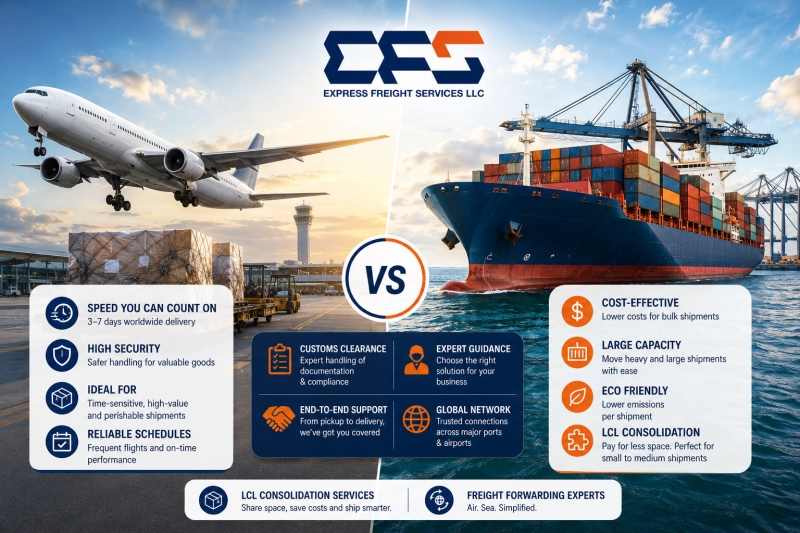
Look, if you're importing or exporting goods, this decision matters. A lot. It'll hit your bottom line hard-we're talking about costs, how fast your stuff arrives, and whether your customers actually get what they ordered on time.
Both air and sea freight have their thing going for them. Air is fast. Sea is cheap. But figuring out which one works for you? That depends on what you're actually shipping, how much you're spending, and whether you need it yesterday or next month.
Express Freight Services LLC handles both. We work with businesses all the time who are stuck between these two choices. So let's actually break this down without the corporate fluff.
Understanding Air Freight Shipping
Air freight gets your cargo where it needs to go. Fast. We're talking days, not weeks. Commercial aircraft, your stuff on board, destination reached pretty quickly.
It's the speed that matters here, especially if you're shipping something that has an expiration date or needs to hit shelves during a specific season.
How Air Freight Actually Works
Here's the real process: Your goods go to an airport. Customs processes them. They load it onto a plane. It flies. It lands at another airport. Then it gets to you.
Sounds simple, right? It mostly is. But there's a lot happening behind the scenes with customs clearance companies and documentation. Express Freight Services handles all that noise so you don't have to.
Benefits of Air Freight
Speed is obvious. If you're shipping electronics, designer goods, or anything with a shelf life, air freight gets it there before it matters that you're losing money every day it sits in transit.
But here's what people don't always think about-reliability. Air freight runs on schedules. Tight ones. You know when your shipment's landing. This matters when you're trying to manage inventory and not disappoint customers. There's no "maybe it'll arrive Tuesday, maybe it'll arrive next month" scenario.
Also, your stuff's safer. Better handling. Less chance of damage or theft. If you're shipping high-value goods, this actually means something.
The Problem with Air Freight
Cost. That's the real issue.
It's expensive. Like, really expensive. You might pay three to five times more than sea freight. For a business shipping heavy or large volumes, this isn't sustainable. It just isn't.
And then there's the environmental thing. Flying stuff around the world burns a lot of fuel. If your customers or your company actually cares about that, it's worth thinking about.
Understanding Sea Freight Shipping
Sea freight is old school. Ships. Containers. Ports. It's how most stuff actually moves across the world, even if nobody talks about it much.
How Sea Freight Actually Works
Your containers get loaded onto ships. Ships follow routes. They take two to four weeks depending on where you're sending stuff. At ports on both ends, customs clearance companies do their thing with paperwork and regulations.
A lot of businesses also use LCL consolidation services here-basically, you share a container with other companies instead of renting the whole thing yourself. Saves money. Takes a bit longer. That's the trade-off.
Why Sea Freight Is Actually Smart
Cost. It's cheap. Really cheap compared to air. For businesses that know what they need and aren't in a rush, this is basically a no-brainer.
You can also move massive amounts of stuff. We're talking containers full of raw materials, machinery, bulk products. If you tried to air freight this, you'd go broke. Sea freight makes it possible.
Modern ships aren't destroying the planet as much as they used to either. Fuel efficiency is better, and when you split emissions across thousands of containers, the per-container environmental impact is actually lower than air freight.
LCL consolidation services? That's a real game-changer for smaller businesses. You don't need a full container anymore. You just pay for the space you use. Makes sea freight accessible for companies that might've thought it was out of reach.
The Downsides of Sea Freight
Time. Two to four weeks is a long time. If your product needs to move faster, this doesn't work.
This also means you're holding more inventory. Tying up capital. Waiting. It adds complexity.
Port congestion happens. Weather delays things. Port strikes. Stuff comes up. And if your customs documentation isn't perfect? You're sitting in a queue somewhere while customs clearance companies sort it out.
Let's Talk About What It Actually Costs
A kilogram of air freight? Three to eight dollars, depending on the route and season.
Sea freight for the same route? Fifty cents to two dollars per kilogram.
Real example: You're shipping fifty grand worth of electronics from China to the US. Air freight is probably eight to fifteen grand. Sea freight with LCL consolidation services? Fifteen hundred to three grand.
Yeah. That's a massive difference.
Customs Clearance and Compliance
Whether you're flying or shipping by sea, you're dealing with customs. No way around it.
Custom clearance agents do the actual work. They make sure your stuff meets regulations, calculate duties and taxes, handle all the forms. They're working with customs clearance companies at ports to move things along.
Express Freight Services knows people at the major ports. We coordinate all this so your shipment doesn't get stuck in bureaucratic limbo. Proper documentation and letting customs know in advance actually makes a huge difference.
LCL Consolidation Services: The Middle Ground
If you're not shipping full containers but you're shipping regularly, LCL consolidation services is worth a real look.
LCL stands for Less Than Container Load. Instead of paying for an entire 20 or 40-foot container, you pay for the space you actually use. Your shipment gets mixed with other businesses' shipments in the same container.
It saves money. Keeps costs down. But yeah, it takes longer because consolidators have to wait to fill containers before they ship. That's the trade-off.
Actually Making This Decision
Air freight makes sense when:
- You need something urgently
- You're shipping high-value stuff that needs security
- Your products have short shelf lives
- You're dealing with seasonal demand or fashion items
Sea freight makes sense when:
- You ship regularly
- You have bulk quantities
- Cost matters more than speed
- You're moving raw materials or manufactured goods
LCL consolidation services? That's your answer if you're shipping less than a full container but need to do it consistently. Best of both worlds.
Real Situation That Actually Happened
A textiles company importing fabric from India to the US had a problem. They needed regular shipments for inventory, so sea freight made sense. Cheap. Worked fine.
Then demand suddenly jumped for one specific product line. Unexpected. They needed more, fast. So they air-freighted a rush shipment while their regular sea freight container was already in transit.
Using Express Freight Services, they ran both at the same time. Sea freight handled the regular supply at low cost. Air freight filled the immediate gap. They balanced cost and responsiveness. It worked.
Wrapping This Up
There's no one answer that works for everyone. It depends on what you're shipping, how soon you need it, your budget, how often you ship.
Air freight wins when speed matters. Sea freight wins when cost matters. LCL consolidation services? That's for when you want the cost benefits of sea freight but don't have enough to fill a container.
Express Freight Services does both. We handle everything from freight forwarding services through to your door. We work with customs clearance companies, manage all the clearance agent responsibilities, make sure your goods move without getting stuck at borders.
Actually Do Something About This
Stop guessing about shipping. Talk to Express Freight Services. Get a real consultation. We'll look at what you're actually shipping and tell you what makes sense.
Air freight for rush orders. Sea freight for regular inventory. LCL consolidation if you need the middle ground. We handle all of it.
Let's figure out what works for your business instead of just picking the option that sounds familiar. You need shipping solutions that actually fit your situation, not generic answers.
Book your Quote Today
Questions People Actually Ask
Q: How much faster is air freight?
A: Air is 3 to 7 days. Sea is 2 to 4 weeks. So about five to ten times faster depending on the route.
Q: Can I use both for one shipment?
A: Absolutely. Lot of businesses do. Urgent items by air, regular stock by sea. Same supplier. Both methods.
Q: What documents do I need for customs?
A: Commercial invoices, packing lists, bills of lading or airway bills, certificates of origin, and whatever specific certifications your product needs. Custom clearance agents check all this.
Q: Is LCL consolidation right for me?
A: If you're shipping less than a full container but doing it regularly, it saves real money. Good for small to medium businesses.
Q: What do customs clearance companies actually do?
A: They handle documentation, calculate duties, process forms, talk to authorities. They make sure you don't get stuck. They minimize delays.
View More Blogs

How Much Does Air Freight to Rustaq Cost? A Guide for importers and exporters
Air freight to Rustaq costs depend on shipment weight, volume, route origin, and urgency, but most i...
Oman Customs Clearance Through Sohar Port: Documents, Duties and Cargo Release
Customs clearance through Sohar Port runs on Oman’s Bayan electronic platform, where importers sub...
LCL Shipping in Seeb in 2026: What Importers Should Know About Costs, Consolidation and Customs
LCL consolidation in Seeb means sharing a container with other importers so you pay only for the spa...