

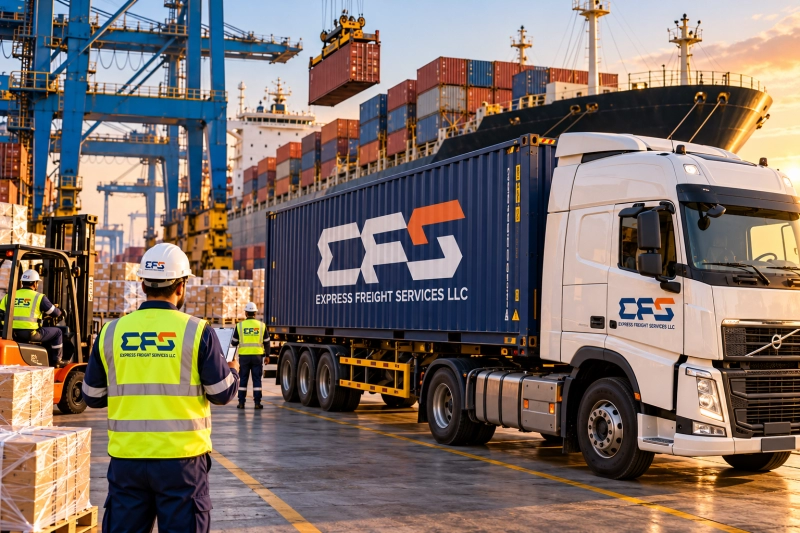
Shipping from Seeb to the UAE is primarily a road freight operation. Most shipments move by truck through the Hatta or Al Ain border crossings, with typical door-to-door transit times of 18 to 48 hours depending on the final emirate and customs clearance speed. For urgent documents, small parcels, or high-value cargo, air freight via Muscat International Airport offers a faster alternative, usually within 1 to 2 days.
The choice between road and air comes down to volume, urgency, and cargo type. Road freight handles everything from a few boxes to full truckloads, while air freight suits time-sensitive commercial samples or perishable goods. Express Freight Services LLC and other regional operators run this lane regularly, so capacity is rarely a problem.
What the Route Actually Looks Like
Seeb sits just west of Muscat, which puts shipments in a convenient position. A truck leaving Seeb typically reaches the UAE border at Al Ain in roughly 6 hours of driving time, though total transit depends on border queues and paperwork readiness. From there, Dubai is a few hours further, with Abu Dhabi and Sharjah adding variable time depending on traffic.
The two main border crossings used for commercial cargo are Hatta (Al Wajajah on the Omani side) and Al Ain (Buraimi on the Omani side). Hatta is the more direct route to Dubai and the northern emirates. Al Ain works better for Abu Dhabi and Al Dhafra deliveries. An experienced forwarder will choose the crossing based on the delivery address, not habit.
Shipping Methods Compared
LCL Consolidation Services in Seeb allow shippers with smaller volumes to share container or truck space rather than paying for unused capacity. This is the practical middle ground between courier pricing and full-truck commitment.
Customs Clearance: What Gets Shipments Held Up
The UAE and Oman are both GCC members, which simplifies some procedures but does not eliminate them. Goods with proper GCC origin documentation may qualify for customs duty exemptions, though a 5% VAT often applies on import into the UAE. The exact treatment depends on the commodity and the HS code classification.
The documents that matter most are the commercial invoice, packing list, and bill of lading or air waybill. A certificate of origin is required where applicable, and some goods need attested certificates. Missing or inconsistent paperwork is the most common cause of border delays, not the physical journey itself.
One practical point: UAE customs uses digital clearance systems, and brokers file declarations before the truck reaches the border. That means the paperwork should be finalised before departure from Seeb, not sorted out at the checkpoint. Forwarders handling Air Freight Forwarding Services in Seeb follow the same principle for airport cargo, pre-clearing where possible to avoid storage charges.
What Most Shippers Overlook
The first mistake is treating the UAE as one destination. Dubai, Abu Dhabi, Sharjah, and the northern emirates each have their own customs authority and free-zone rules. A shipment cleared for Dubai World Central may need different handling for Khalifa Port or Hamriyah Free Zone. Specify the exact delivery address and authority from the start.
The second is under-declaring or misclassifying goods to save on duty. UAE customs penalties for incorrect HS codes can be severe, and repeat issues flag the importer for inspection. Accurate 12-digit HS classification is worth the effort.
The third is ignoring packing standards. Summer temperatures on the Seeb to Al Ain route regularly exceed 40°C inside truck trailers. Heat-sensitive goods need insulated or refrigerated transport, and even general cargo benefits from proper palletising and load securing.
Choosing a Forwarder for This Lane
A forwarder is an intermediary who arranges transport, customs brokerage, and delivery without owning the trucks or aircraft themselves. For the Seeb to UAE lane, the right forwarder has daily or near-daily departures, a UAE-based customs broker, and a local delivery network rather than handing cargo to a third party at the border.
Ask whether the forwarder handles free-zone deliveries directly, whether they provide proof of delivery, and how they communicate delays. The cheapest quote often means the shipment waits for a full truck or gets consolidated through a slower routing.
For documentation-heavy shipments, working with a provider that offers customs clearance and documentation services in Seeb removes a major friction point. The forwarder prepares the declaration, checks the invoice against the packing list, and flags missing certificates before the truck moves.
Practical Steps Before You Ship
- Confirm the exact UAE delivery address, including free zone or mainland status.
- Prepare the commercial invoice with accurate values and HS codes.
- Check whether your goods need a certificate of origin or attestation.
- Decide between FTL, LTL, courier, or air freight based on volume and urgency.
- Pack for heat exposure and rough handling at border inspection points.
The route from Seeb to the UAE is short enough that most problems are avoidable with preparation. If you are unsure which method fits your cargo, reach out and a forwarder will walk you through the best route based on what you are actually shipping and where it needs to land.
Contact us today for a free consultation
Frequently Asked Questions
1.How much does it cost to ship things to Dubai?
Costs depend on shipment volume, weight, transport method, and whether customs duties or VAT apply. Road LTL is generally the most economical for part loads, while air freight and express courier services carry a premium for speed. The only accurate way to price a shipment is to provide the cargo details, dimensions, and delivery address for a quote.
2.Who is a shipping forwarder?
A shipping forwarder is a logistics intermediary that arranges transport, customs clearance, and delivery on behalf of a shipper. Forwarders do not typically own trucks or aircraft; they coordinate carriers, handle documentation, and manage the movement from pickup to final delivery.
3. What are some UAE-based shipping companies?
The UAE has a mix of global logistics providers, regional freight forwarders, and local courier companies operating across road, sea, and air freight. Many Omani forwarders also maintain UAE-based customs brokers and delivery partners to handle the final leg of cross-border shipments.
4. What is the average salary for a freight forwarder in Dubai?
Salaries for freight forwarders in Dubai vary widely based on experience, employer, and specialisation. Entry-level operations roles sit at the lower end, while senior positions handling key accounts or specialised cargo earn substantially more. Current market data from UAE recruitment sources gives the most accurate picture.
View More Blogs

Customs Clearance Delays in Seeb: Common Causes and How to Avoid Them
Customs clearance delays in Seeb typically stem from documentation errors, HS code misclassification...
Air Freight Cost from Dubai in 2026: Rates, Chargeable Weight and Hidden Fees
Air freight from Dubai typically runs between AED 12 and AED 40 per kilogram depending on destinatio...
Road Freight to Khasab from the UAE: Documents, Costs and Delivery Planning
Road freight from the UAE to Khasab moves through the Musandam Peninsula, combining standard GCC tru...